




































Why Is Human Error Still Responsible for 90% of Cyber Incidents in 2025?
Imagine spending millions on the most advanced firewalls, AI-driven threat detection, and zero-trust architecture, only to watch your company get breached because someone clicked “Yes, this email from the CEO looks legitimate.” That is not a rare exception. It is the rule. Year after year, reports from Verizon, IBM, Microsoft, and Stanford all converge on the same uncomfortable truth: roughly 90% of successful cyberattacks still involve human error in some form. This article goes beyond the statistic. We will explore the psychology, behavioral science, and human-factor theories that explain why this number refuses to drop, even in an age of sophisticated technology.
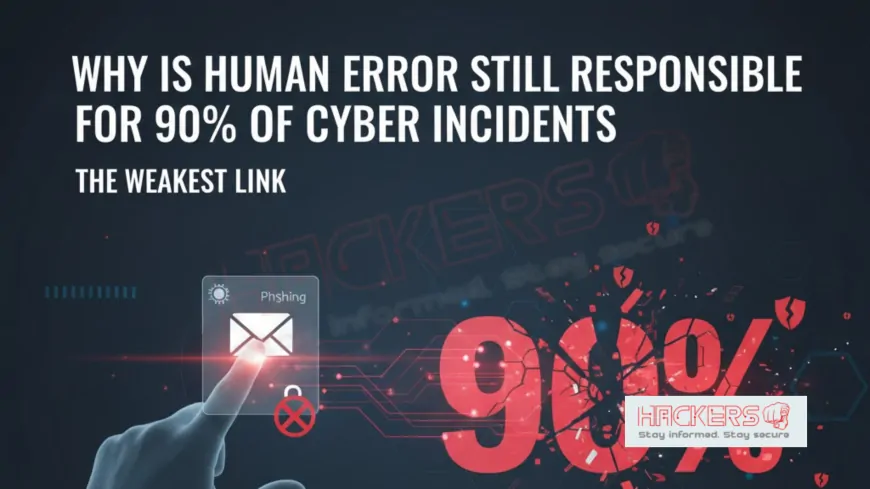
Table of Contents
- The Origin and Accuracy of the 90% Statistic
- Most Common Forms of Human Error Today
- The Science and Theory Behind Persistent Human Error
- Key Psychological and Behavioral Models
- Debunking Myths Around the 90% Figure
- Human Error vs. Pure Technical Failure: Data Comparison
- Evidence-Based Solutions That Actually Move the Needle
- Conclusion: Redesign Systems for Real Humans
The Origin and Accuracy of the 90% Statistic
The number first appeared prominently in reports from the mid-2010s and has been remarkably stable ever since. The 2024 Verizon DBIR attributes 68% of breaches directly to the “human element,” but when stolen credentials, misuse, and misconfiguration are added, the total rises above 90%. IBM’s 2025 Cost of a Data Breach report similarly finds that compromised credentials (almost always obtained through phishing or weak/reused passwords) remain the top initial attack vector.
Most Common Forms of Human Error in 2025
- Phishing and business email compromise (BEC)
- Credential reuse and weak password practices
- Clicking malicious links or attachments
- Cloud misconfiguration (public buckets, exposed APIs)
- Sharing one-time codes or passwords during live attacks
- Falling for vishing (voice phishing) and smishing
- Physical device loss without encryption
- Insider error or intentional misuse
The Science and Theory Behind Persistent Human Error
Security professionals often treat human error as a training problem, but psychologists and human-factors researchers see it as a predictable outcome of how the human brain actually works in modern digital environments.
1. Cognitive Load Theory (John Sweller, 1988)
Our working memory can only hold about 4–7 pieces of information at once. When employees are bombarded with 150 emails a day, urgent Slack messages, and looming deadlines, the cognitive resources needed to carefully inspect every sender address or URL simply do not exist. Phishing succeeds because it arrives at moments of peak cognitive load.
2. Prospect Theory and Loss Aversion (Kahneman & Tversky, 1979)
People fear immediate losses (missing a CEO request, delaying a payment) far more than distant, probabilistic losses (a potential breach). Attackers exploit this by creating urgency: “Invoice must be paid in 2 hours or services will be suspended.” The perceived cost of inaction outweighs the perceived risk.
3. Automation Bias and Complacency
When tools like email gateways and antivirus silently mark messages as safe, users assume they are safe. This is called automation bias. The more faith we place in technology, the less vigilance we apply ourselves.
4. The Dunning-Kruger Effect in Cybersecurity
People with limited knowledge tend to overestimate their ability to spot scams. Conversely, experts sometimes underestimate sophisticated attacks because they believe their own defenses are stronger than they really are.
5. Habituation and Alarm Fatigue
After seeing hundreds of “This email was blocked” banners, employees start ignoring all warnings. The brain learns to treat security alerts as background noise.
“The brain did not evolve to detect Base64-encoded malicious PowerShell in an email at 3 p.m. on a Friday while three Slack channels are exploding. It evolved to spot lions on the savanna.”
— Dr. Jessica Barker, human behavior in cybersecurity researcher
Key Models That Explain Why Training Alone Fails
| Model / Theory | Core Idea | Real-World Cybersecurity Implication |
|---|---|---|
| Swiss Cheese Model (James Reason, 1990) | Accidents happen when multiple layers of defense have holes that momentarily align. | Even if 99% of employees resist phishing, the 1% who click on a bad day create the hole attackers need. |
| Human Factors Analysis and Classification System (HFACS) | Errors stem from organizational influences, supervision failures, preconditions, and active failures. | Blaming the employee ignores poor policies, understaffing, and bad tool design upstream. |
| Protection Motivation Theory (Rogers, 1975) | People protect themselves only when they perceive high threat, high probability, and high self-efficacy. | If employees believe “IT will catch it anyway,” motivation to act securely collapses. |
| Technology Acceptance Model (Davis, 1989) | Users reject tools that are not perceived as useful and easy to use. | Clunky MFA solutions get bypassed; password managers get ignored if not enforced. |
Debunking Common Myths About the 90% Figure
- Myth: “90% means users are careless or stupid.”
Reality: Highly trained pilots and surgeons still make errors; cybersecurity asks far more decisions from far less trained people. - Myth: “Better technology will eliminate human error.”
Reality: Technology shifts the error, it does not remove it (e.g., misconfigured AI policies). - Myth: “Only old people fall for scams.”
Reality: Gen Z falls for Instagram giveaway scams and deepfake video calls at similar rates.
Human Error vs. Pure Technical Failure: 2023–2025 Data Comparison
| Human Error Category | Key Statistic (2025) | Source/Impact |
|---|---|---|
| Phishing and Social Engineering | 95% of security incidents linked to human error, with phishing as top vector | Stanford/Verizon; Average click rate 17.8%, up to 53% for targeted attacks |
| Weak Passwords and Credential Misuse | 81% of hacking breaches from weak/reused passwords; 49% of breaches involve compromised credentials | Verizon/IBM; Cost per incident: $779K |
| Insider Threats and Negligence | 55% of insider incidents due to negligence; 8% of employees cause 80% of incidents | Ponemon/Mimecast; Annual cost: $17.4M per org |
| Misconfiguration and Cyber Hygiene Failures | 92% of incidents preventable with better hygiene; 73% take >24h to patch | Swimlane/Check Point; Includes shadow IT and unpatched systems |
| Awareness and Training Gaps | 33% PPP drops to 4.1% after training; 86% reduction in click rates | KnowBe4; 74% of CISOs cite human error as top risk |
| Overall Human Element in Breaches | 68-95% of breaches involve human factor | Verizon/IBM/Mimecast; Global cost of breaches: $10.5T |
Evidence-Based Solutions That Actually Reduce Human Error
- Deploy phishing-resistant MFA (FIDO2 hardware keys or passkeys) – reduces successful phishing by 99%+
- Enforce managed passwordless or password-manager solutions
- Run continuous, low-friction simulated phishing with immediate micro-training
- Default-deny email attachments and links, route through secure portals
- Apply least privilege rigorously (no local admin rights)
- Segment networks and use zero-trust verification
- Design processes assuming humans will err (approval workflows, delay timers on large transfers)
- Measure and reward caution, not just speed
Conclusion: Redesign Systems for Real Humans, Not Perfect Ones
The 90% statistic is not a verdict on human intelligence. It is a verdict on system design. We have built an environment that demands hundreds of perfect security decisions per week from people who are tired, distracted, and under pressure, then act surprised when someone eventually slips.
Behavioral science and decades of human-factors research tell us exactly what to do: stop trying to turn humans into perfect antivirus software. Instead, build defenses that assume mistakes will happen and ensure those mistakes cannot cascade into catastrophes.
Until we do that, the number will stay at 90%. The moment we start designing for real human behavior, we can finally make it fall.
What psychological theory best explains phishing success?
Cognitive Load Theory combined with Prospect Theory: high mental workload plus fear of immediate negative consequences overrides rational caution.
Is human error really 90% or is the number exaggerated?
It is not exaggerated. Different reports range from 82% to 95% depending on methodology, but the consensus is overwhelmingly above 85% when all contributing human factors are counted.
Why do even CISOs and security engineers fall for scams?
Because the brain’s threat-detection shortcuts (heuristics) work the same for everyone when cognitive resources are depleted.
Will AI and machine learning finally eliminate the human problem?
AI will reduce some errors but will create new ones (prompt injection, model poisoning, over-reliance). Attackers adapt faster than defenses mature.
What is the Swiss Cheese Model in cybersecurity?
Every defense layer has holes. A breach occurs when the holes momentarily line up. Human error is usually one of those holes.
Is annual security awareness training worthless?
Traditional checkbox training has almost zero measurable long-term effect. Short, frequent, context-rich simulations work dramatically better.
Why do people still reuse passwords in 2025?
Because the average person has 200+ accounts and organizations still fail to enforce password managers or passwordless options.
Which single control has the biggest impact on the 90% number?
Phishing-resistant MFA (hardware keys or passkeys). It breaks the credential-theft chain that powers most attacks.
Do younger generations make fewer security mistakes?
No. They make different ones (fake giveaways, deepfake calls, crypto scams) at similar rates.
Is misconfiguration considered human error?
Yes, 100%. Leaving a cloud database public is a human decision, even if unintentional.
Why don’t we just block all attachments and external links?
Some organizations do exactly that and remain highly secure. Most cannot because legitimate business still relies on email file transfer.
Can we ever get human-related incidents below 50%?
Yes. Organizations using passwordless authentication, hardware keys, zero-trust, and continuous simulation routinely achieve near-zero successful phishing.
What is the main takeaway for non-technical employees?
You do not need to be perfect. You just need to slow down for ten seconds and verify anything that feels urgent or unusual.
Are insider threats included in the 90%?
Yes, both malicious and accidental insider actions are classified as human-element incidents.
Why do some reports quote 74% instead of 90%?
They count only the initial vector. When secondary human contributions (misconfiguration, delayed patching, etc.) are added, the total rises.
Is remote work making the problem worse?
It increases risk factors (distraction, unsecured networks, personal devices), but strong controls can neutralize them.
Will passkeys solve the human error problem completely?
They solve credential phishing and reuse (huge wins), but live social engineering (vishing, fake support calls) still requires human judgment.
What is automation bias?
The tendency to trust computer output over your own judgment. When an email is marked “safe,” most people stop checking.
Is there any industry where human error is NOT the dominant factor?
No major sector is below 80%. Healthcare, finance, government, and critical infrastructure all hover in the high 80s to low 90s.
Final thought: who is really responsible for the 90%?
The systems that continue to place impossible security demands on fallible humans, not the humans themselves.
What's Your Reaction?