





















How the Boom of Computers in the 1990s Increased Cyber Threats
Picture this: it is 1990 and your family just brought home a shiny new Windows 95 computer with a screaming 28.8k modem. Suddenly, the world is at your fingertips. You can send email, chat with strangers, download games, and visit websites that look like colorful magazines. It felt magical. Almost nobody worried about viruses, hackers, or stolen passwords because "the internet" still seemed like a toy. Within ten short years, that innocence was gone forever. The same explosion that put a computer in every home and school also created perfect conditions for cyber threats to grow from rare curiosities into daily nightmares. This blog post explains exactly how the 1990s technology boom accidentally supercharged cybercrime and why we are still cleaning up the mess today.
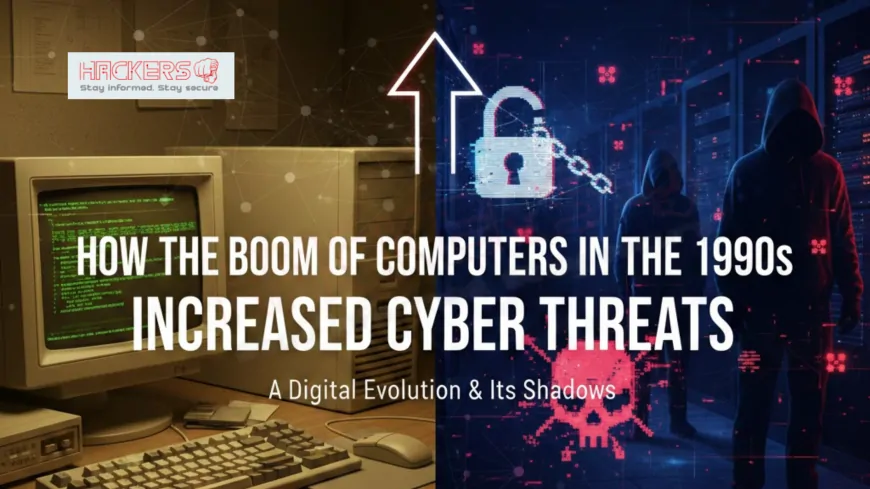
Table of Contents
- The Explosive Boom: From 1 Million to 300 Million Users
- Cheap Home Computers + Modems = Millions of Unprotected Machines
- The World Wide Web Makes Everything Clickable and Shareable
- Email Becomes the Perfect Virus Delivery Truck
- Script Kiddies: Tools for Everyone, Skills for No One
- The Most Famous 1990s Attacks That Shocked the World
- Why Defenses Could Not Keep Up
- Businesses Rush Online Without Security
- Timeline of the 1990s Cyber Threat Explosion
- Conclusion
- Frequently Asked Questions
The Explosive Boom: From 1 Million to 300 Million Users
In 1990, fewer than 1 million people used the internet worldwide. By 1999, the number was over 300 million. Home internet subscriptions grew 100 times in some countries. Schools connected classrooms. Libraries offered free access. Coffee shops started putting in phone lines for laptops. Every new user was a potential victim and, unknowingly, a potential spreader of malware.
Cheap Home Computers + Modems = Millions of Unprotected Machines
- 1991: A decent PC cost around $2,000
- 1995: Windows 95 machines under $1,000
- 1998: Sub-$600 computers in supermarkets
These machines shipped with almost no security. No firewall, weak passwords (or none), and automatic file-sharing turned on. People connected 24/7 with "always-on" cable or DSL by the end of the decade. Attackers suddenly had millions of poorly protected targets that never turned off.
The World Wide Web Makes Everything Clickable and Shareable
Tim Berners-Lee invented the web in 1989–1991, but it exploded after 1993 when Mosaic and Netscape browsers arrived. Suddenly anyone could publish a page, and anyone could click links. Free web hosting (GeoCities, Angelfire, Tripod) let people share files easily. Downloaded games, screensavers, and "cool cursor" programs often carried viruses. Users had no idea that a dancing baby GIF could wipe their hard drive.
Email Becomes the Perfect Virus Delivery Truck
Services like Hotmail (1996) and AOL made email free and simple. By 1999, people were sending dozens of messages a day, including attachments and forwards. This created the perfect storm for macro viruses (tiny programs hidden inside Word and Excel files). One click on "I Love You" or "Anna Kournikova photo" and your entire address book was infected in minutes.
Script Kiddies: Tools for Everyone, Skills for No One
The 1990s gave birth to "script kiddies" – teenagers or beginners who downloaded ready-made hacking tools instead of writing their own. Websites and IRC chat rooms offered free password crackers, trojans, and denial-of-service tools. A 14-year-old with no real knowledge could take down a company website or steal AOL accounts. This democratized attacks and made threats far more common.
The Most Famous 1990s Attacks That Shocked the World
- 1994 – Vladimir Levin steals $10 million from Citibank using dial-up
- 1995 – Kevin Mitnick arrested after years of high-profile hacks
- 1998 – Cult of the Dead Cow releases Back Orifice remote-control tool
- 1999 – Melissa virus spreads to 1 million computers in days, causes $80 million damage
- 2000 – Mafiaboy (15-year-old Canadian) knocks Yahoo, eBay, CNN offline with DDoS attacks
Why Defenses Could Not Keep Up
- Most home antivirus (Norton, McAfee) was optional and cost extra
- Updates came on floppy disks or CDs, not automatically
- Windows 95/98 had no built-in firewall until late patches
- People reused passwords like "password123" everywhere
- Companies thought "we're too small to be targeted"
Businesses Rush Online Without Security
Amazon launched in 1995, eBay in 1995, PayPal in 1998. Banks put accounts online. None of them had years of experience securing public websites. Early e-commerce sites often stored credit card numbers in plain text. Hackers quickly learned they could make real money, not just bragging rights.
Timeline of the 1990s Cyber Threat Explosion
| Year | Event | Why It Mattered |
|---|---|---|
| 1993 | Mosaic browser released | Web becomes easy for everyone |
| 1995 | Windows 95 + Internet Explorer | Millions of homes go online |
| 1996 | Hotmail launches free email | Email becomes universal |
| 1998 | Back Orifice released | Remote control for any Windows PC |
| 1999 | Melissa macro virus | First global email worm, $80m damage |
| 2000 | ILOVEYOU virus | $15 billion damage, 50 million infections |
Conclusion
The 1990s were the decade when computers stopped being tools for experts and became toys for everyone. That same openness and excitement created the perfect storm for cyber threats to explode. Cheap PCs, easy web browsing, free email, and almost zero built-in security turned hundreds of millions of new users into unwitting participants in the spread of malware. The attacks we remember from that era (Melissa, ILOVEYOU, Mafiaboy) were not especially clever by today’s standards, but they worked because the world rushed online faster than it learned to stay safe. Every modern security habit we now take for granted (automatic updates, firewalls, antivirus by default, "don’t open strange attachments") was born as a direct reaction to the chaos of the 1990s. The boom gave us the internet we love, but it also gave us the cyber threats we still fight every day.
What made the 1990s different for cyber threats?
Millions of unprotected home computers suddenly connected to the internet with almost no security knowledge.
How many people were online by 1999?
Roughly 300 million, up from under 1 million in 1990.
Why were 1990s computers so vulnerable?
No built-in firewall, optional antivirus, always-on connections, and users unaware of risks.
What was the Melissa virus?
A 1999 macro virus that spread through Outlook and mailed itself to the first 50 contacts.
Who was Mafiaboy?
A 15-year-old Canadian who took down major websites in 2000 using DDoS attacks.
Did people pay for antivirus in the 1990s?
Many did not; it was seen as optional until viruses became common.
What is a macro virus?
A virus hidden inside Word or Excel documents that runs when you open the file.
Why was email so dangerous in the 1990s?
Everyone used it, trusted attachments, and address books spread infections instantly.
When did the first web browser appear?
Mosaic in 1993 made the web easy and popular.
Why did script kiddies appear in the 1990s?
Free hacking tools were shared widely on websites and IRC.
What is Back Orifice?
A 1998 remote-control tool that could take over any Windows 95/98 PC.
Did businesses have firewalls in the 1990s?
Very few; most went online with direct connections.
When did AOL make the internet mainstream?
Mid-1990s with "You’ve Got Mail" and endless free trial CDs.
What was the ILOVEYOU virus?
A 2000 Visual Basic script that overwrote files and mailed itself; caused $15 billion damage.
Why couldn’t antivirus stop Melissa fast?
Updates were manual and took days to reach users.
Did schools teach internet safety in the 1990s?
Almost never; most teachers were learning alongside students.
What lesson did the 1990s teach the world?
Convenience and openness must be balanced with security from day one.
Are we still affected by 1990s decisions?
Yes: weak default settings, password reuse, and email trust issues all started then.
When did automatic updates become normal?
Not until Windows XP in 2001–2002, as a direct reaction to 1990s viruses.
Why do we say the 1990s "created" modern cyber threats?
Because that decade turned rare expert attacks into everyday problems for ordinary people.
What's Your Reaction?