





What Makes Blockchain-Based Authentication More Secure Than Passwords?
Picture this: you wake up to a flurry of emails alerting you that your bank account has been accessed from halfway across the world. Your heart races as you realize your password, the one you thought was clever enough, has been cracked by a hacker. Stories like this are all too common in 2025, with data breaches exposing billions of passwords and leading to massive financial losses. According to recent reports, automated attacks on passwords happen every 39 seconds, and weak passwords are behind 49 percent of breaches. It is clear that traditional passwords are failing us in this digital age. But what if there was a better way, a system that does not rely on easily guessed strings of characters? Enter blockchain-based authentication. This innovative approach uses the power of decentralized technology to create a more secure method of verifying identities. In this blog post, we will explore why blockchain authentication is gaining traction as a superior alternative to passwords. We will break it down step by step, explaining the concepts in simple terms so even those new to the topic can follow along. By the end, you will see how this technology could reshape online security for the better.
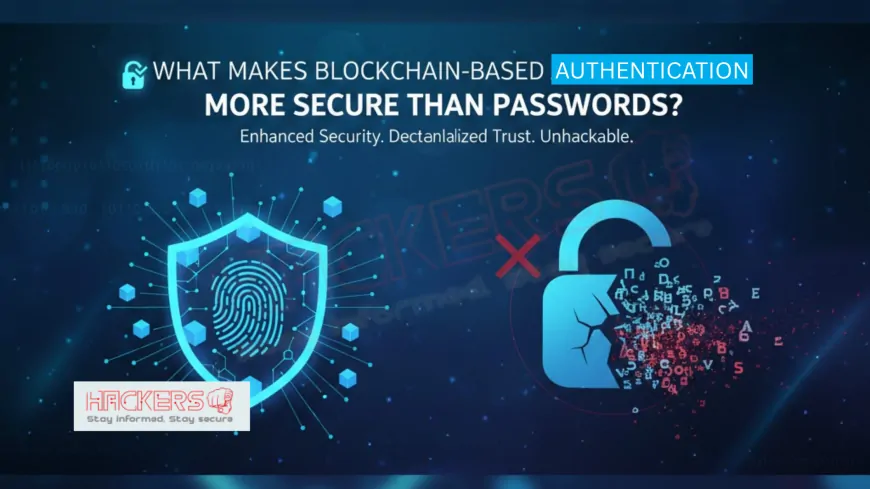
Table of Contents
- The Weaknesses of Traditional Passwords
- Understanding Blockchain Technology
- How Blockchain-Based Authentication Works
- Comparing Blockchain Authentication to Passwords
- Key Advantages of Blockchain Authentication
- Real-World Examples of Blockchain Authentication
- Challenges and Limitations
- Conclusion
- Frequently Asked Questions
The Weaknesses of Traditional Passwords
For decades, passwords have been the go-to method for securing online accounts. They seem simple: create a unique combination of letters, numbers, and symbols, and you are set. However, reality tells a different story. Passwords are inherently flawed, and these flaws make them vulnerable to attacks.
One major issue is human error. People often choose weak passwords that are easy to remember, like "123456" or "password." Statistics show that 79 percent of passwords mix common words and numbers, making them susceptible to brute-force attacks where hackers try many combinations quickly.
Data breaches amplify these problems. In 2025, a massive leak exposed 1.3 billion unique passwords, many of which had never been seen before.
Centralized storage is another weak point. Most services store passwords in databases. Even with hashing, a technique that scrambles passwords, breaches can expose them. Attackers use rainbow tables, precomputed hash lists, to crack them. Plus, phishing scams trick users into giving away passwords directly.
Passwords also struggle with scalability. As we juggle more accounts, remembering strong, unique passwords becomes impossible. Password managers help, but they are not foolproof: if compromised, they expose everything. Multi-factor authentication adds layers, but it relies on passwords as the base.
These weaknesses lead to staggering losses. In 2025, organizations feel they have failed to secure passwords adequately in 62 percent of cases.
Understanding Blockchain Technology
Blockchain might sound complicated, but at its core, it is a secure way to record information. Think of it as a digital ledger, like a notebook that many people share. Each entry is a block, and blocks link together in a chain. Once added, a block cannot be changed without altering the whole chain, which requires agreement from the network.
This technology powers cryptocurrencies like Bitcoin, but its uses go beyond money. Blockchain is decentralized, meaning no single company or government controls it. Instead, copies exist on computers worldwide, called nodes. Transactions are verified through consensus, where nodes agree on validity.
Security comes from cryptography. Each block has a hash, a unique code based on its content. Changing data changes the hash, alerting the network. Public-key cryptography uses pairs of keys: public for sharing, private for securing. This setup ensures only owners access their data.
For authentication, blockchain offers a tamper-proof system. Unlike passwords stored centrally, blockchain distributes identity data. Users control their info, sharing only what is needed. This reduces risks from central breaches.
Blockchain also enables smart contracts, self-executing code that automates processes. In authentication, they can verify identities without middlemen. While blockchain has challenges like speed, its security benefits make it promising for replacing passwords.
How Blockchain-Based Authentication Works
Blockchain-based authentication flips the script on traditional methods. Instead of passwords, it uses cryptographic keys and decentralized ledgers to verify users.
It starts with creating a digital identity. Users generate a key pair: a public key, shared like an address, and a private key, kept secret like a password but much stronger. The private key signs data, proving ownership without revealing itself.
When logging in, the system challenges the user to sign a message with their private key. The public key verifies the signature. This proves possession without transmitting sensitive info.
Blockchain stores identity attributes immutably. For example, a verified email or phone is recorded as a credential. Users present these without exposing details, using zero-knowledge proofs: math that proves something true without showing how.
Decentralized identifiers, or DIDs, are unique codes not tied to central authorities. They let users manage identities across services. Verifiable credentials, issued by trusted parties, are stored on the blockchain for easy checking.
This system is passwordless, reducing risks from weak or stolen passwords. It is also user-centric, giving control over data. In practice, apps like wallets use this for secure access. As adoption grows, it could become standard for online logins.
Comparing Blockchain Authentication to Passwords
To see why blockchain is more secure, let's compare it directly to passwords. Passwords rely on shared secrets, vulnerable to guessing or theft. Blockchain uses asymmetric cryptography, where secrets stay private.
Centralized vs decentralized: Passwords are stored in databases, easy targets. Blockchain distributes data, no single failure point.
Tamper resistance: Passwords can be changed in breaches. Blockchain's immutability prevents alterations without consensus.
User control: With passwords, services hold your data. Blockchain lets you manage it, sharing minimally.
Scalability: Passwords lead to reuse. Blockchain keys are unique per use, reducing risks.
Here is a table highlighting the differences:
| Aspect | Password-Based | Blockchain-Based |
|---|---|---|
| Storage | Centralized databases | Decentralized ledger |
| Vulnerability to Breaches | High, single point of failure | Low, distributed and immutable |
| User Control | Limited, service-managed | High, self-sovereign |
| Resistance to Tampering | Low, hashes can be cracked | High, requires network consensus |
| Privacy | Exposed in transmissions | Enhanced with zero-knowledge proofs |
This comparison shows blockchain's edge in security.
Key Advantages of Blockchain Authentication
Blockchain authentication offers several benefits over passwords. First, enhanced security. Cryptographic keys are harder to crack than passwords. Private keys are long, random strings, resistant to brute-force.
Second, reduced risk from breaches. No central storage means no massive leaks. Even if one node is compromised, the network remains secure.
Third, better privacy. Users share only necessary info, using techniques like zero-knowledge proofs. This minimizes data exposure.
Fourth, resistance to phishing. No passwords to steal; verification uses keys not transmitted.
Fifth, scalability and usability. Once set up, it is seamless. No remembering complex passwords; devices handle keys.
Sixth, interoperability. Blockchain identities work across platforms, reducing reuse risks.
Research shows blockchain reduces unauthorized access, though with trade-offs like speed.
Real-World Examples of Blockchain Authentication
Blockchain authentication is not just theory; it is in use today. One example is Estonia's e-Residency program, which uses blockchain for secure digital identities. Residents access services with tamper-proof verification.
Microsoft's ION, or Identity Overlay Network, builds on Bitcoin for decentralized identities. Users control data, sharing verifiable credentials securely.
REMME offers decentralized authentication, replacing passwords with SSL certificates on blockchain.
Financial transactions benefit too. Systems use blockchain for improved security in logins and transfers.
Challenges and Limitations
While promising, blockchain authentication has hurdles. Speed is one: transactions can be slower than password checks, due to consensus.
Scalability issues arise with large networks. Handling millions of authentications requires efficient design.
Key management is tricky. Losing a private key means losing access, with no easy recovery. Users need education on backups.
Adoption barriers exist. Integrating with existing systems takes time and cost. Regulations vary, complicating rollout.
Privacy concerns: while enhanced, public ledgers might expose metadata. Solutions like private blockchains help.
Trade-offs include higher processing costs for improved security.
Conclusion
Blockchain-based authentication stands out as more secure than passwords due to its decentralization, immutability, and cryptographic strength. It addresses key weaknesses like breaches and reuse, offering better privacy and control. Real examples like Estonia's e-Residency show its potential. While challenges like speed exist, the advantages make it a forward-thinking solution. As breaches rise, adopting blockchain could safeguard our digital lives.
Frequently Asked Questions
What are the main weaknesses of passwords?
Passwords are prone to guessing, reuse, and breaches from centralized storage.
How does blockchain improve security?
It uses decentralization and cryptography to prevent single points of failure and tampering.
What is a private key?
A secret code that proves ownership and signs transactions securely.
What are zero-knowledge proofs?
Methods to verify information without revealing the details.
Is blockchain authentication faster than passwords?
No, it can be slower due to consensus, but improvements are ongoing.
What is immutability?
The inability to change data once recorded on the blockchain.
Can I lose access with blockchain auth?
Yes, if you lose your private key, recovery is difficult.
What is a DID?
A decentralized identifier for managing identities without central control.
Are passwords obsolete?
Not yet, but blockchain offers a stronger alternative.
How does it prevent phishing?
No passwords to steal; verification uses keys not transmitted.
What is hashing?
Creating a unique code from data for verification.
Can blockchain be hacked?
The network is hard to hack due to consensus, but individual keys can be stolen.
What is consensus?
The process where nodes agree on data validity.
Is it user-friendly?
It requires learning, but apps make it easier.
What are verifiable credentials?
Digital proofs stored on blockchain for secure sharing.
How many passwords were leaked in 2025?
1.3 billion unique passwords were exposed in one leak.
Does it work for all apps?
Not yet, but integration is growing.
What is public-key cryptography?
Using key pairs for secure communication and verification.
Are there costs?
Transactions may have fees, but authentication can be low-cost.
Why not just use biometrics?
Biometrics can be stolen; blockchain adds tamper-proof layers.
What's Your Reaction?