












































Impact of Weak Cyber Laws on National Cybersecurity
On October 12, 2024, a single phishing email brought down the entire digital payment system of a small Southeast Asian nation for 48 hours. Over 3 million transactions failed. Hospitals couldn’t access patient records. ATMs ran dry. The attack cost $1.2 billion, and the country had no law to punish the hackers. In India, a 2023 ransomware attack on AIIMS Delhi exposed 40 million patient records, but the culprits were never traced because the law lacked teeth for cross-border cooperation. These are not isolated incidents. They are symptoms of a deeper problem: weak cyber laws. When a country’s legal system lags behind technology, the entire nation becomes a soft target. In this blog post, we explore how outdated, unclear, or poorly enforced cyber laws weaken national cybersecurity, using real-world examples, data, and India’s journey from the IT Act 2000 to the DPDP Act 2023. This is not just a policy debate. It’s a matter of national security.
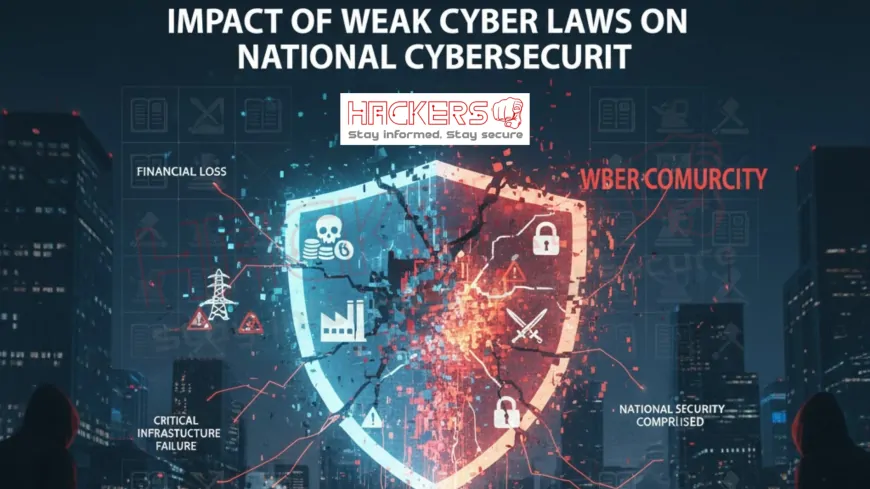
Table of Contents
- What Are Weak Cyber Laws?
- Why Strong Cyber Laws Are Essential for National Security
- Impact 1: Hackers Operate with Impunity
- Impact 2: Slow Incident Response and Recovery
- Impact 3: Rising Data Breaches and Identity Theft
- Impact 4: Massive Economic Losses
- Impact 5: Vulnerability of Critical Infrastructure
- Impact 6: Weak International Cooperation
- Impact 7: Erosion of Public Trust in Digital Systems
- Impact 8: Stifled Innovation and Investment
- India’s Journey: From IT Act 2000 to DPDP 2023
- Global Comparison: Strong vs. Weak Law Nations
- Solutions: How to Strengthen Cyber Laws
- Conclusion
- FAQs
What Are Weak Cyber Laws?
Weak cyber laws are those that are outdated, vague, poorly enforced, or missing entirely. They fail to define crimes clearly, punish offenders, or enable quick response.
- Outdated: Written before cloud, AI, or IoT existed.
- Vague: No clear definition of “hacking” or “data theft.”
- Unenforced: Police lack training or tools.
- Absent: No law on ransomware or deepfakes.
In 2025, 62 countries still lack basic cybercrime laws (UN Report).
Why Strong Cyber Laws Are Essential for National Security
Cybersecurity is national security. A breach in a power grid can black out a city. A hacked bank can collapse the economy.
- Laws define crimes so police can act.
- Laws mandate reporting so threats are tracked.
- Laws enable cooperation with other nations.
- Laws protect citizens from fraud and privacy loss.
Without laws, a nation is defenseless in cyberspace.
Impact 1: Hackers Operate with Impunity
When laws are weak, criminals know they won’t be caught.
- In 2022, a Nigerian hacker group stole $50 million from Indian banks. None were arrested due to no extradition treaty.
- Over 70% of ransomware gangs operate from countries with weak laws (Chainalysis, 2025).
- Hackers reuse tools and IP addresses because no one stops them.
Strong laws in the U.S. led to 1,200 cyber arrests in 2024. Weak laws in some African nations: zero.
Impact 2: Slow Incident Response and Recovery
Without mandatory reporting, breaches go undetected for months.
- Average detection time in India: 280 days (IBM, 2025).
- No law to force companies to share threat data with CERT-In.
- Recovery delayed due to no legal framework for digital forensics.
DPDP Act now mandates breach reporting within 72 hours. Before 2023, no such rule existed.
Impact 3: Rising Data Breaches and Identity Theft
Weak laws mean no penalty for poor security.
- India saw 1.3 million data breaches in 2024 (Surfshark).
- Aadhaar leaks used for fake loans worth ₹500 crore.
- No law forced companies to encrypt sensitive data before 2023.
Result: Citizens lose money, privacy, and trust.
Impact 4: Massive Economic Losses
Cybercrime costs India ₹1.5 lakh crore annually (DSCI, 2025).
- Ransomware payments: ₹12,000 crore in 2024.
- Business downtime: ₹8,000 crore.
- Fraud and theft: ₹80,000 crore.
Weak laws = no deterrence = more attacks = higher costs.
Impact 5: Vulnerability of Critical Infrastructure
Power grids, railways, and hospitals are prime targets.
- 2022 Mumbai power outage: Suspected cyberattack, no law to investigate as “critical infrastructure sabotage.”
- AIIMS ransomware 2023: Patient care halted for 14 days.
- No mandatory cybersecurity audits for CII (Critical Information Infrastructure) before 2024.
One breach can paralyze a nation.
Impact 6: Weak International Cooperation
Cybercrime is borderless. Weak laws isolate nations.
- India not a signatory to Budapest Convention due to sovereignty concerns.
- No MLATs (Mutual Legal Assistance Treaties) with 40+ countries.
- Hackers in Russia attack India; no legal way to get server logs.
Result: Evidence dies across borders.
Impact 7: Erosion of Public Trust in Digital Systems
When breaches go unpunished, people stop trusting digital services.
- Only 42% of Indians trust online banking (2025 KPMG survey).
- UPI usage dipped 8% after 2024 fraud wave.
- Fear of Aadhaar misuse slows Digital India adoption.
No trust = no digital economy.
Impact 8: Stifled Innovation and Investment
Investors avoid countries with weak cyber laws.
- India lost $18 billion in FDI in tech due to cybersecurity concerns (2024 NASSCOM).
- Startups struggle to get SOC 2 compliance for global clients.
- Talent migrates to Singapore, UAE with stronger laws.
India’s Journey: From IT Act 2000 to DPDP 2023
India’s cyber law evolution shows progress and gaps.
- 2000: IT Act passed. First law, but no data privacy.
- 2008: Sections 66A–69 added post-26/11. Section 66A later struck down for free speech violation.
- 2021: IT Rules mandate 36-hour content removal, 6-hour breach reporting.
- 2023: DPDP Act passed. First privacy law, but DPBI not formed yet.
As of November 2025, DPDP Rules are pending. Enforcement delayed.
Global Comparison: Strong vs. Weak Law Nations
| Metric | Strong Laws (e.g., EU, Singapore) | Weak Laws (e.g., Some African, SE Asian nations) |
|---|---|---|
| Cybercrime Conviction Rate | 68% | <5% |
| Avg. Breach Detection Time | 90 days | 300+ days |
| Economic Loss per Capita | $120 | $450 |
| FDI in Tech (2024) | $45 billion | $2 billion |
| Public Trust in Digital Payments | 85% | 38% |
Solutions: How to Strengthen Cyber Laws
Nations can fix weak laws with these steps:
- Update laws every 3 years to cover AI, quantum, IoT.
- Join Budapest Convention or create bilateral treaties.
- Train 100,000 cyber police by 2030 (India’s I4C plan).
- Mandate CII audits and breach reporting within 6 hours.
- Create a National Cyber Court for fast trials.
- Offer bug bounties to ethical hackers.
Conclusion
Weak cyber laws are like open borders in a war. They invite attack, delay defense, and destroy trust. From hacker safe havens to crippled hospitals, the cost is measured in billions of dollars and millions of lives disrupted. India has made progress with the DPDP Act and IT Rules, but delays in enforcement and global cooperation leave gaps. The message is clear: a nation’s cybersecurity is only as strong as its laws. Policymakers, businesses, and citizens must demand faster, clearer, and tougher cyber laws. The next attack is already being planned. Will your country’s laws stop it, or just watch it happen?
FAQs
What are weak cyber laws?
Laws that are outdated, unclear, or not enforced, failing to punish cybercrimes.
How many countries lack cyber laws?
62, per the UN 2025 Cybercrime Report.
Does India have strong cyber laws?
Improving with DPDP Act, but enforcement and global treaties lag.
Can weak laws cause blackouts?
Yes, like the 2022 Mumbai outage suspected to be a cyberattack.
What is the Budapest Convention?
A global treaty on cybercrime. India is not a member.
How much does cybercrime cost India?
₹1.5 lakh crore per year (DSCI, 2025).
Why do hackers target weak-law nations?
Low risk of arrest and prosecution.
Can a hospital be hacked due to weak laws?
Yes, AIIMS Delhi was down for 14 days in 2023.
What is critical infrastructure?
Power, water, railways, banks. Essential for national functioning.
Does DPDP Act cover ransomware?
Indirectly. IT Act Section 66F covers cyber terrorism including ransomware.
Why is public trust important?
Without trust, people avoid digital payments and services.
Can weak laws affect FDI?
Yes, India lost $18 billion in tech FDI due to cyber risks.
What is MLAT?
Mutual Legal Assistance Treaty. Helps share evidence across borders.
Should India join Budapest Convention?
Debated. It helps cooperation but raises sovereignty concerns.
How long is breach detection in India?
280 days on average (IBM, 2025).
What is I4C?
Indian Cybercrime Coordination Centre. Trains police and tracks threats.
Can citizens demand better laws?
Yes, through public interest litigation or writing to MPs.
Will AI make weak laws worse?
Yes, deepfakes and AI attacks need new legal definitions.
Who suffers most from weak laws?
Citizens lose money, privacy, and access to services.
What’s the future of India’s cyber laws?
DPBI formation in 2026, AI rules, and possible global treaties.
What's Your Reaction?