






































How the Rise of the Internet Created a New Era of Cybercrime
When the internet first entered homes in the 1990s, it felt like magic. You could send a letter in seconds, shop without leaving the couch, and talk to someone on the other side of the planet for free. Almost nobody worried about crime, because the online world still seemed separate from real life. Money was still in wallets, secrets were on paper, and criminals robbed banks with guns, not keyboards. That innocence lasted only a few years. As soon as millions of people and billions of dollars moved online, a completely new kind of criminal appeared: one who could steal from the comfort of their bedroom, hide behind fake names, and disappear across borders with a click. The rise of the internet did not just change how we live. It created the first truly global, borderless crime wave in human history. This blog post tells that story in simple terms: how the same technology that connected us also connected criminals, and how cybercrime grew from teenage pranks into a multi-trillion-dollar shadow industry.
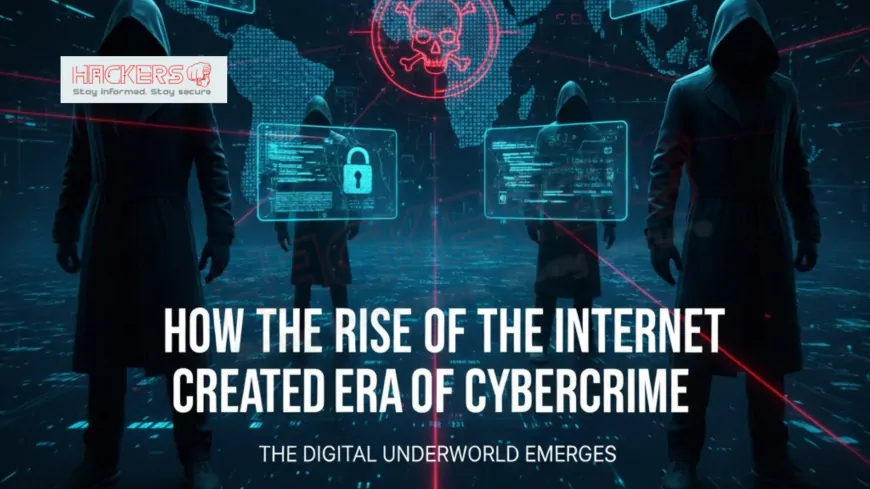
Table of Contents
- Before the Internet: Crime Needed Physical Presence
- 1990s: The Internet Goes Public and Crime Follows
- 2000s: Money Moves Online – Crime Becomes Profitable
- 2000s: Tools and Markets Make Cybercrime Easy for Anyone
- 2010s: Ransomware, Crypto, and Organized Gangs
- 2020s–Today: Nation-States and Billion-Dollar Heists
- Why the Internet Was the Perfect Crime Platform
- Timeline: From Curious Hackers to Global Cybercrime
- Conclusion
- Frequently Asked Questions
Before the Internet: Crime Needed Physical Presence
Before 1990, almost all crime required you to be there in person. Rob a bank? You needed a mask and a getaway car. Steal identities? You dug through trash for documents. Fraud? You mailed fake cheques. Distance and borders protected people. A criminal in Russia could not easily steal from a shop in California. Computers existed, but they were locked in offices and not connected to each other. Crime was local, slow, and risky.
1990s: The Internet Goes Public and Crime Follows
- 1993–1996: World Wide Web explodes, millions get online
- 1995: First online banks and shops appear
- 1997: First known phishing emails pretending to be AOL
- 1999: Melissa virus spreads via email, causes $80 million damage
Teenagers discovered they could break into websites for fun and fame. Groups like L0pht and Cult of the Dead Cow released free hacking tools. Most early cybercrime was about bragging rights, not money.
2000s: Money Moves Online – Crime Becomes Profitable
Everything changed when real money went digital:
- 1998–2004: PayPal, eBay, Amazon payments boom
- 2005–2009: Banking moves online worldwide
- 2007: TJX breach steals 45 million credit cards
- 2008–2009: First large underground carding forums appear
Criminals realized they could steal thousands of cards in one hack and sell them for cash. Nigerian 419 scams evolved into professional phishing sites that looked exactly like real banks.
2000s: Tools and Markets Make Cybercrime Easy for Anyone
The dark web and underground forums turned crime into a business:
- Ready-made viruses sold for $10–$100
- Stolen credit cards sold for $1–$20 each
- “Crime-as-a-Service”: rent a botnet for $50 a day
- Cryptocurrency (Bitcoin 2009) gives untraceable payments
You no longer needed to be a genius programmer. Anyone with a few hundred dollars could become a cybercriminal.
2010s: Ransomware, Crypto, and Organized Gangs
- 2013: CryptoLocker – first successful ransomware demanding Bitcoin
- 2016: Bangladesh Bank heist – $81 million stolen via SWIFT network
- 2017: WannaCry infects 200,000 computers in 150 countries
- 2018–2021: Groups like REvil and Conti run ransomware like real companies
Cybercrime became organized. Russian, North Korean, Iranian, and Chinese groups operated with offices, HR departments, and customer support.
2020s–Today: Nation-States and Billion-Dollar Heists
Cybercrime is now worth trillions annually:
- 2021: Colonial Pipeline pays $4.4 million ransom
- 2022: Costa Rica declares national emergency over Conti ransomware
- 2024–2025: AI-powered phishing and deepfake scams explode
- Nation-states (Russia, China, North Korea, Iran) run attacks for money and power
A single successful hack can earn more than a traditional bank robbery ever could, with almost zero risk of getting caught.
Why the Internet Was the Perfect Crime Platform
- Global reach: Attack anyone from anywhere
- Anonymity: Hide behind fake names and VPNs
- Low cost: A laptop and internet connection is enough
- High reward: Steal millions in minutes
- Border problems: Police stop at country lines, criminals do not
- Speed: Malware spreads worldwide in hours
Timeline: From Curious Hackers to Global Cybercrime
| Period | Main Activity | Motive |
|---|---|---|
| Pre-1995 | Phone phreaking, BBS hacks | Curiosity, fun |
| 1995–2000 | Website defacement, early viruses | Fame |
| 2000–2009 | Carding, phishing banks | Money (small scale) |
| 2010–2016 | Ransomware, crypto theft | Money (organized) |
| 2017–2025 | Nation-state attacks, AI scams | Money + power |
Conclusion
The internet did not invent crime, but it completely transformed it. It removed distance, lowered risk, and multiplied rewards. What started as teenagers exploring systems for fun turned into the largest transfer of wealth in history, from ordinary people and companies to hidden criminal networks. Today, cybercrime is bigger than the illegal drug trade. The same connection that lets you video-call your family in another country also lets a criminal in Eastern Europe lock your files and demand ransom. We cannot unplug the internet, but we can understand how it changed crime forever. Every strong password, every software update, and every “verify it’s really your bank” email is part of the long fight that began the moment the web went public.
When did cybercrime become profitable?
Around 2004–2007 when online banking and shopping became widespread.
What was the first big money-making cybercrime?
Stealing and selling credit card numbers from breaches like TJX in 2007.
Why is it hard to catch cybercriminals?
They hide behind fake names, use VPNs, and operate from countries that do not cooperate with police.
What role did Bitcoin play?
It gave criminals an anonymous way to receive payments, starting in 2009.
What is ransomware?
Malware that encrypts your files and demands payment to unlock them.
Who invented ransomware?
The idea started in 1989, but CryptoLocker in 2013 made it hugely profitable.
Can police shut down cybercrime gangs?
Sometimes, but new groups appear quickly.
Which country has the most cybercriminals?
Many operate from Russia, Ukraine, North Korea, Nigeria, and Romania.
Is cybercrime bigger than drug trafficking?
Yes, estimates say cybercrime costs the world $8–10 trillion per year.
What was the Melissa virus?
A 1999 email virus that spread rapidly and caused $80 million in damage.
What is carding?
Buying and selling stolen credit card details on underground forums.
Why did cybercrime explode after 2010?
Bitcoin, easy ransomware tools, and professional gangs.
Do nation-states commit cybercrime?
Yes, North Korea, Russia, China, and Iran run attacks for money and intelligence.
What is the dark web?
Hidden websites that require special software, where most cybercrime tools are sold.
Was the internet designed to be secure?
No, it was built for researchers who trusted each other.
Can cybercrime ever be stopped?
Not completely, but good security habits make it much harder for criminals.
What is the biggest cybercrime today?
Ransomware attacks on hospitals, cities, and companies.
How much did WannaCry cost?
Over $4 billion worldwide in 2017.
Why do criminals use cryptocurrency?
It is hard to trace compared to bank transfers.
What can I do to avoid becoming a victim?
Use strong unique passwords, enable two-factor authentication, and never click suspicious links.
What's Your Reaction?