


































How Cybersecurity Research Grew in Universities Worldwide
Imagine the year 1985. The internet is a tiny network used mostly by researchers. Almost no one outside the military talks about "cybersecurity." Then a few professors notice strange things happening on their computers. They start asking questions, writing papers, and teaching students how to protect systems. Fast forward to 2025, and universities around the world run huge labs, train thousands of experts every year, and discover most of the new defenses we use against hackers. What started as a handful of curious professors has become one of the biggest research fields on the planet. This is the story of how universities, not companies or governments, built the science of keeping the digital world safe.
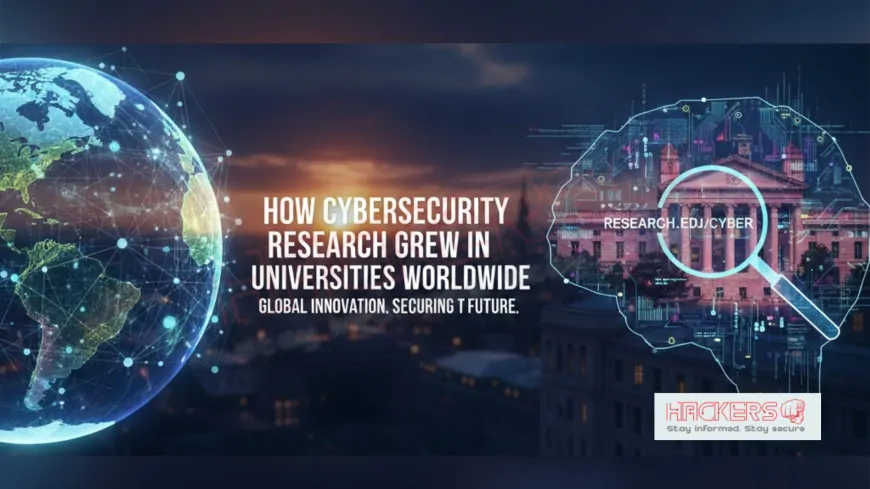
Table of Contents
- The Early Days: 1970s–1980s
- The First Dedicated Research Centers (1990s)
- Government Funding and Centers of Excellence
- The Global Explosion After 2000
- From Pure Computer Science to Interdisciplinary Work
- Top University Cybersecurity Labs in 2025
- How Universities Train the Next Generation
- Industry Partnerships and Real-World Impact
- Challenges Universities Still Face
- The Future of University Cybersecurity Research
- Table of Milestone University Cybersecurity Centers
- Conclusion
- FAQs
The Early Days: 1970s–1980s
In the beginning, security research happened by accident. Professors who studied operating systems or networks noticed flaws and wrote papers about them. Places like MIT, Stanford, and the University of California, Berkeley were home to the first ARPANET nodes, so they saw problems first. In 1975, the U.S. Department of Defense published the “Orange Book” on trusted computer systems, and academics started testing those ideas. By the late 1980s, Dorothy Denning at Purdue and Gene Spafford were teaching full courses and publishing groundbreaking work on intrusion detection.
The First Dedicated Research Centers (1990s)
The real change came when universities created dedicated labs. Purdue launched COAST in 1993, which became CERIAS in 1998, the first large interdisciplinary center. Carnegie Mellon started CERT (Computer Emergency Response Team) after the 1988 Morris Worm. UC Davis, Naval Postgraduate School, and Georgia Tech quickly followed. These centers brought together computer scientists, psychologists, lawyers, and even economists to study security as a human and social problem, not just a technical one.
Government Funding and Centers of Excellence
In 1999, the U.S. National Security Agency and Department of Homeland Security created the Centers of Academic Excellence (CAE) program. Schools that met strict standards received funding and recognition. By 2025, over 400 universities in the U.S. alone carry the CAE label. Similar programs now exist in the UK (NCSC-certified degrees), Europe (ECHAlliance), Singapore, Australia, and Israel. Government money allowed labs to buy equipment, hire faculty, and offer scholarships.
The Global Explosion After 2000
The 2000s saw security research spread worldwide. Cambridge and Oxford in the UK, ETH Zurich in Switzerland, Technion in Israel, and Tsinghua University in China built world-class programs. In Asia, South Korea’s KAIST and Singapore’s NUS became leaders. By 2010, the top security conferences (USENIX Security, IEEE S&P, ACM CCS, NDSS) regularly featured papers from dozens of countries. Today, the best new ideas often come from universities in Europe, Asia, or the Middle East, not just the United States.
From Pure Computer Science to Interdisciplinary Work
Modern university research looks very different from 1990. Labs now study:
- Psychology of phishing (why people click bad links)
- Economics of cybercrime (how attackers make money)
- Law and policy (privacy rules, international treaties)
- Human-computer interaction (making security tools easier to use)
- Artificial intelligence for both attack and defense
This mix produces better solutions because real attacks involve people, money, and laws, not just code.
Top University Cybersecurity Labs in 2025
- Purdue University CERIAS (USA) – oldest and largest
- Carnegie Mellon CyLab (USA) – huge industry funding
- ETH Zurich (Switzerland) – leader in systems security
- University of Cambridge (UK) – strong in policy and economics
- Technion (Israel) – world-class cryptography
- KAIST (South Korea) – top in Asia for mobile and AI security
- TU Darmstadt (Germany) – privacy and anonymous communication
- University of Oxford (UK) – cyber-physical systems and governance
How Universities Train the Next Generation
Most countries now offer bachelor’s, master’s, and PhD programs in cybersecurity. Students do real research, compete in capture-the-flag contests, and often intern at companies or government agencies. Many schools run “red team / blue team” labs where one group attacks and another defends. Graduates are in such high demand that companies recruit them years before graduation.
Industry Partnerships and Real-World Impact
Universities work closely with tech giants. Google, Microsoft, Meta, and Apple fund research chairs and sponsor PhD students. Discoveries move quickly from lab to product. Examples include memory-safe languages (Rust), formal verification tools, and new privacy technologies like differential privacy.
Challenges Universities Still Face
- Funding depends too much on government contracts in some countries
- Top researchers are lured away by industry salaries
- Publishing sensitive vulnerabilities responsibly is tricky
- Keeping up with AI and quantum computing threats
The Future of University Cybersecurity Research
By 2030 we expect even more growth in quantum-safe cryptography, AI security, and cyber-physical systems (think power grids and self-driving cars). Universities in Africa, Latin America, and Southeast Asia are building strong programs. Open science and international collaboration will be key.
Table of Milestone University Cybersecurity Centers
| Year Founded | University / Center | Country | Notable Achievement |
|---|---|---|---|
| 1988 | CERT/CC, Carnegie Mellon | USA | First computer emergency response team |
| 1998 | CERIAS, Purdue University | USA | First large interdisciplinary center |
| 2003 | CyLab, Carnegie Mellon | USA | Largest university lab by funding |
| 2004 | ETH Zurich Information Security | Switzerland | Global leader in systems security |
| 2010s | KAIST Cybersecurity Center | South Korea | Top mobile and AI security research |
| 2015 | Oxford Cyber Security Centre | UK | Strong policy and governance focus |
Conclusion
Universities turned a niche curiosity into a global science. From a few professors in the 1980s to thousands of researchers across every continent in 2025, academic labs remain the beating heart of cybersecurity progress. They train the experts, invent the ideas, and ask the hard questions companies sometimes avoid. The next time you update your phone, use a password manager, or read about a new zero-day vulnerability, remember: a university researcher probably discovered it, tested it, or taught the person who did. The digital world is safer because universities never stopped studying how to protect it.
When did universities start serious cybersecurity research?
Real focused research began in the late 1980s after incidents like the Morris Worm.
What was the first big university security center?
CERIAS at Purdue University, founded in 1998.
What is a CAE school?
A university recognized by the U.S. NSA/DHS as a Center of Academic Excellence in cybersecurity.
How many CAE schools exist in 2025?
Over 400 in the United States alone.
Which country has the most university cybersecurity programs?
The United States, followed by the UK, Germany, and South Korea.
Do universities only study technical topics?
No, modern research includes law, psychology, economics, and policy.
Can I study cybersecurity with no computer background?
Yes, many programs welcome students from social sciences, law, or business.
Are university research tools free?
Most academic tools and papers are open-source or freely available.
How do students get real experience?
Through labs, capture-the-flag contests, internships, and red/blue team exercises.
Which university is best for cryptography?
Technion (Israel) and ETH Zurich are consistently ranked at the top.
Do companies fund university research?
Yes, Google, Microsoft, Meta, and many others sponsor labs and students.
Is cybersecurity research only in rich countries?
No, strong programs now exist in Brazil, India, South Africa, and Indonesia too.
What is the biggest challenge for university researchers?
Keeping talented professors when industry pays much more.
Can university research be used in real products?
Yes, examples include Rust language, Tor, and many privacy tools.
Are there cybersecurity PhD programs outside the USA?
Yes, excellent ones in the UK, Switzerland, Germany, Israel, Singapore, and Australia.
Why is interdisciplinary research important?
Because attacks involve people, money, and laws, not just computers.
Will universities stay important in the future?
Yes, they train people and do long-term research companies often skip.
Where can I read university cybersecurity papers?
Free sites like ePrint.iacr.org, USENIX, and university websites.
What is the best way to start?
Take a free online course from a top university (many offer them on Coursera or edX).
Do universities share research with governments?
Yes, but they also publish openly when possible to help everyone.
What's Your Reaction?