








How Can Blockchain Transform Digital Voting Security?
Every few years, millions of people around the world watch election results come in and wonder the same thing: did my vote actually count, and was it counted correctly? In 2020, 2021, and again in 2024, accusations of fraud, lost ballots, hacked machines, and human error made headlines. Yet in the same period, tiny countries and even cities have quietly run elections on blockchain that were transparent, verifiable by anyone, and impossible to silently change. In 2025, nations like Estonia, Switzerland, and South Korea are already using blockchain for parts of their voting systems, while others are running large-scale pilots. Blockchain will not magically fix every problem with democracy, but it can solve some of the hardest ones: making every vote permanently recorded, publicly auditable, and mathematically provable without revealing who cast it. This blog post explains in simple, honest language how blockchain voting actually works, what it can and cannot do, real examples from today, and why many experts believe it is the future of secure digital elections.
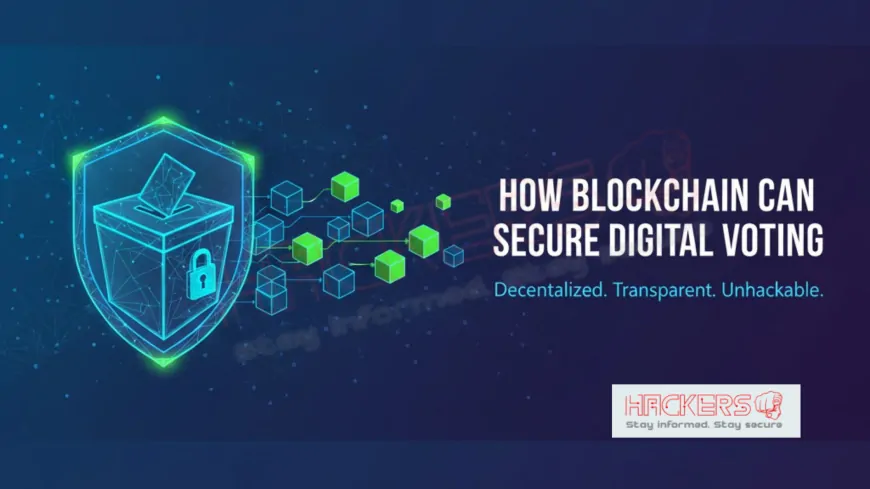
Table of Contents
- The Real Problems with Today’s Voting Systems
- How Blockchain Solves the Hardest Problems
- Four Core Features Every Blockchain Voting System Needs
- Real-World Examples in 2025
- Traditional Voting vs. Blockchain-Enhanced Voting
- How Blockchain Voting Keeps Your Choice Secret
- Challenges and Honest Limitations
- The Future: 2030 and Beyond
- Conclusion
- Frequently Asked Questions
The Real Problems with Today’s Voting Systems
- Paper ballots can be lost, damaged, or stuffed
- Electronic machines can be hacked or have software bugs
- Central databases are single points of failure
- Voters cannot personally verify their vote was counted
- Election officials are trusted to not manipulate results
- Recounts are slow, expensive, and still disputed
How Blockchain Solves the Hardest Problems
- Immutability: Once a vote is recorded on the blockchain, no one can change or delete it
- Transparency: Anyone can download the entire vote ledger and count it themselves
- Decentralization: Copies exist on thousands of independent computers
- Verifiability: Every voter gets a receipt to check their own vote was included
- Cryptographic proof: Math guarantees the final tally is correct
Four Core Features Every Blockchain Voting System Needs
- End-to-end verifiability: Voters and observers can prove the system worked correctly
- Coercion resistance: No one can prove how someone else voted (prevents vote buying)
- Secret ballot: Your choice stays private even though the ledger is public
- One person, one vote: Identity is verified without linking it to the vote
Real-World Examples in 2025
- Estonia: Uses blockchain-inspired KSI technology for all e-governance signatures since 2008
- Switzerland: Zug and several cantons run legally binding blockchain votes for residents
- South Korea: National Assembly and local elections use blockchain for overseas absentee voting
- Sierra Leone: 2018 presidential election used blockchain for tally transparency (Agnes project)
- Moscow, Russia: Multiple city referendums on Polygon-based platform
- West Virginia, USA: 2018 and 2020 used mobile blockchain voting for military overseas
- Thailand, Brazil, India: Large-scale pilots for party primaries and cooperatives
Traditional Voting vs. Blockchain-Enhanced Voting
| Feature | Traditional Paper/Electronic | Blockchain-Enhanced |
|---|---|---|
| Can votes be changed after casting? | Possible (human or hack) | Mathematically impossible |
| Can anyone verify the final count? | Only officials | Anyone with internet |
| Does the voter know their vote counted? | Usually no | Yes, via receipt code |
| Is voter privacy guaranteed? | By procedure | By cryptography |
| Survives server destruction? | No | Yes |
How Blockchain Voting Keeps Your Choice Secret
Modern systems use:
- Zero-knowledge proofs: Prove you are eligible and voted once without showing your choice
- Homomorphic encryption: Tally votes while they stay encrypted
- Mix-nets or ring signatures: Shuffle votes so no one can trace them back
- Blind signatures: Election authority signs your vote without seeing it
Challenges and Honest Limitations
- Voter authentication: How do you prove identity online without central databases?
- Coercion and vote selling: Someone can force you to vote on camera at home
- Digital divide: Not everyone has a smartphone or internet
- Complexity: Harder to explain than paper ballots
- Trust in code: A bug could be catastrophic
- Legal acceptance: Many countries still require paper trails
The Future: 2030 and Beyond
- Hybrid systems: Paper + blockchain audit trail (best of both worlds)
- Self-sovereign identity: Use government-issued digital IDs on your phone
- National blockchain voting for referendums and local elections first
- Global standards led by IEEE, NIST, and Council of Europe
- Integration with zero-knowledge proofs for perfect privacy
Conclusion
Blockchain cannot fix politics, stop lies, or make everyone agree on results. But it can solve the technical problems that cause the most doubt: lost votes, altered counts, and unverifiable tallies. When every citizen can personally check that their vote is in the final ledger, and any observer can independently verify the total, trust in elections increases dramatically. We do not need to replace paper overnight. Starting with overseas voters, party primaries, and small referendums shows the technology works in the real world. In 2025, blockchain voting is no longer science fiction. It is running today in real elections, and it is only a matter of time before more countries follow.
Frequently Asked Questions
Can blockchain voting be hacked?
The blockchain itself is extremely hard to hack. The bigger risks are voter devices and identity systems.
Is my vote secret on a public blockchain?
Yes, when zero-knowledge proofs or homomorphic encryption are used correctly.
Which country uses blockchain voting the most?
Switzerland (Zug and other cantons) and Estonia (for e-governance integrity).
Can I vote from my phone?
Yes, in pilots in Switzerland, Russia, South Korea, and West Virginia.
Does blockchain replace paper ballots?
Not yet in most places. Many use it as an immutable audit layer beside paper.
Can someone sell their vote?
Harder than with paper, but not impossible if coercion happens at home.
Who controls the blockchain in elections?
Usually a consortium of government, universities, and civil society nodes.
Is blockchain voting expensive?
Initial setup yes, but long-term cheaper than printing and counting paper.
Do voters need cryptocurrency?
No. Voting tokens are free and issued only to eligible citizens.
Can disabled or elderly people use it?
Yes, with good app design and in-person help centers.
Has any national election used full blockchain voting?
Not yet in 2025, but South Korea and Switzerland are close for parts of their process.
What happens if my phone is stolen?
Two-factor authentication and biometric locks protect the vote.
Can observers from other countries verify?
Yes, the ledger is public and borderless.
Is it legal in my country?
Varies. Many allow pilots; full replacement usually needs new laws.
Does blockchain prevent voter suppression?
No, but it makes registration and vote recording transparent.
Who audits blockchain voting systems?
Independent cryptographers, universities, and international observers.
Can votes be recounted instantly?
Yes, anyone can re-tally the entire election in seconds.
Is Estonia’s system fully blockchain?
It uses KSI blockchain for integrity of all e-services, including voting records.
Will we ever go back to only paper?
Unlikely. Hybrid paper + blockchain is the most trusted future model.
Where can I try blockchain voting today?
Look for local shareholder meetings, DAO governance votes, or pilot programs in Switzerland and South Korea.
What's Your Reaction?