





Why Should Students Learn Digital Forensics in 2025?
Imagine waking up one morning to find your bank account empty, your social media hijacked, and your private photos posted online. Now multiply that by millions. That is the world we live in today. Cybercrime is no longer a rare event; it is a daily reality. The people who investigate these crimes, recover stolen data, and bring attackers to justice are digital forensics experts. In 2025, learning digital forensics is not just for future detectives or government agents. It is one of the smartest career and life skills any student can pick up, no matter what field they plan to enter. This post explains why, in simple terms, every student should seriously consider adding digital forensics to their toolbox.
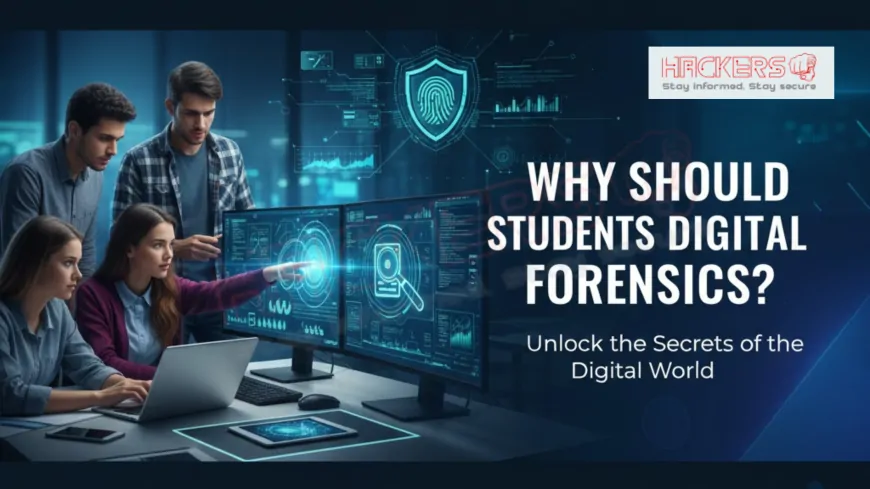
Table of Contents
What Is Digital Forensics, Really?
Digital forensics is the science of finding, preserving, analyzing, and presenting data from computers, phones, cloud accounts, IoT devices, and even cars in a way that is legally acceptable. It answers questions like:
- Who sent that threatening email?
- Was company data stolen before an employee quit?
- Where was this phone when the crime happened?
- Was this cryptocurrency wallet used for illegal activity?
It combines computer science, law, and detective work. You do not need to be a hacker; you need to be curious, patient, and detail-oriented.
The Job Market Is Exploding
Cybercrime now costs the world over $10 trillion per year and is growing fast. Every company, hospital, school, and government agency is a target. They all need people who can investigate incidents.
| Job Role | Global Demand Growth (2023-2030) | Average Shortage | Typical Entry-Level Salary (USD) |
|---|---|---|---|
| Digital Forensics Analyst | +33% | Very High | $75,000 – $95,000 |
| Incident Response Analyst | +35% | Critical | $80,000 – $110,000 |
| Malware Reverse Engineer | +28% | High | $90,000 – $130,000 |
| eDiscovery Specialist (Legal) | +25% | Growing | $70,000 – $100,000 |
Source: Cybersecurity Ventures, ISC², and U.S. Bureau of Labor Statistics 2024-2025 reports
Salary and Career Paths
- Entry-level digital forensics roles now commonly start above $75,000 in the U.S. and €60,000 in Europe.
- Experienced investigators in corporate or law enforcement easily earn $120,000–$180,000+.
- Freelance and consulting rates can reach $300+ per hour.
- Many roles are remote-friendly and globally in demand.
Career options include law enforcement, corporate security teams, insurance companies, law firms, consulting firms, banks, and even starting your own practice.
Transferable Skills for Any Career
Even if you never work as a full-time forensics examiner, the skills you learn are pure gold:
- Critical thinking and problem solving
- Data analysis and pattern recognition
- Understanding operating systems (Windows, Linux, macOS, Android, iOS)
- Legal and ethical reasoning
- Report writing and presenting evidence
- Basic programming and scripting (Python, PowerShell)
- Cloud forensics (AWS, Azure, Google Workspace, iCloud)
These skills make you valuable in cybersecurity, IT audit, compliance, data analytics, and even traditional detective work.
Why 2025 Is the Perfect Year to Start
- New laws (EU NIS2, U.S. state privacy laws, etc.) require companies to investigate every breach.
- Deepfakes, AI-generated evidence, and cryptocurrency crimes are creating brand-new forensics challenges.
- Cars, smart homes, and medical devices now generate evidence in criminal cases.
- Free and low-cost training (SANS scholarships, TryHackMe, LetsDefend, Blue Team Labs) has never been more accessible.
- Universities and community colleges are adding affordable certificates and degrees.
Common Myths About Digital Forensics
- Myth: You need to be a computer genius. Reality: Curiosity and patience matter more than genius.
- Myth: It is only for police. Reality: 70%+ of jobs are in the private sector.
- Myth: Everything is deleted forever when you empty the trash. Reality: Most data can be recovered until overwritten.
- Myth: It is boring lab work. Reality: Many investigators travel, testify in court, and work on high-profile cases.
How and Where Students Can Learn It Today
- Free platforms: TryHackMe Digital Forensics room, LetsDefend, TCM Security free courses
- Affordable bootcamps: SANS FOR308, Champlain College Online, University of Maryland Global Campus
- Certifications: CompTIA Cybersecurity Analyst, GIAC Certified Forensic Analyst (GCFE), Certified Computer Forensics Examiner (CCFE)
- University programs: Purdue, University of Central Florida, Bloomsbury (UK), and many community colleges now offer 100% online degrees
- High school: Many CTE programs and magnet schools teach basic forensics
Conclusion
In 2025, digital evidence is everywhere. Every click, photo, message, and transaction leaves a trace. The world desperately needs sharp, ethical people who can find the truth in that data.
Learning digital forensics gives you job security, excellent pay, and the satisfaction of solving real puzzles that affect real lives. Whether you want to fight cybercrime, protect companies, help innocent people in court, or simply understand the digital world better, digital forensics is one of the most future-proof skills you can learn today.
Do not wait for the perfect moment. Start with a free lab this weekend. The next big case might be waiting for you to solve it.
What is digital forensics in simple terms?
It is the process of collecting and analyzing digital evidence the same way crime scene investigators collect fingerprints or DNA.
Do I need a computer science degree?
No. Many professionals come from criminal justice, law, accounting, or even liberal arts backgrounds.
Is digital forensics only for law enforcement?
No. Most jobs are in companies, consulting firms, insurance, and law firms.
How long does it take to learn the basics?
You can learn useful skills in 3-6 months with consistent practice.
Can I learn digital forensics for free?
Yes. Platforms like TryHackMe, LetsDefend, and YouTube have excellent free courses.
Is it a stressful job?
It can be intense during incidents, but most corporate roles have normal working hours.
Do I have to be good at math?
No. Basic math is enough. Logic and curiosity are more important.
Will AI replace digital forensics investigators?
No. AI helps with speed, but human judgment is required for court and complex cases.
Can I do digital forensics on phones?
Yes. Mobile forensics is one of the fastest-growing areas.
Is it ethical to learn these skills?
Absolutely, when learned and used responsibly. Ethical training is part of every good course.
Do girls/women work in digital forensics?
Yes, and the field actively wants more women. Diversity makes teams stronger.
Can I start while still in high school?
Yes. Many students compete in CyberPatriot and begin learning forensics early.
Is it true deleted files can still be recovered?
Usually yes, until the space is overwritten with new data.
Do I need expensive tools?
No. Open-source tools like Autopsy, Volatility, and Magnet RAM Capture are free and powerful.
Can digital forensics help with bullying or harassment cases?
Yes. Investigators often help schools and families trace online harassment.
Is cryptocurrency forensics part of it?
Yes. Blockchain analysis is now a hot specialty.
Will the field still exist in 10 years?
It will be even bigger. Every device and app creates more evidence every year.
Can I work remotely?
Many forensics and analysis work is often fully remote.
Do I have to go to court?
Sometimes, but many investigators never testify. It depends on the role.
What is the first step I should take today?
Download the free Autopsy tool and follow a beginner YouTube tutorial. You will be analyzing a disk image in under an hour.
What's Your Reaction?