











































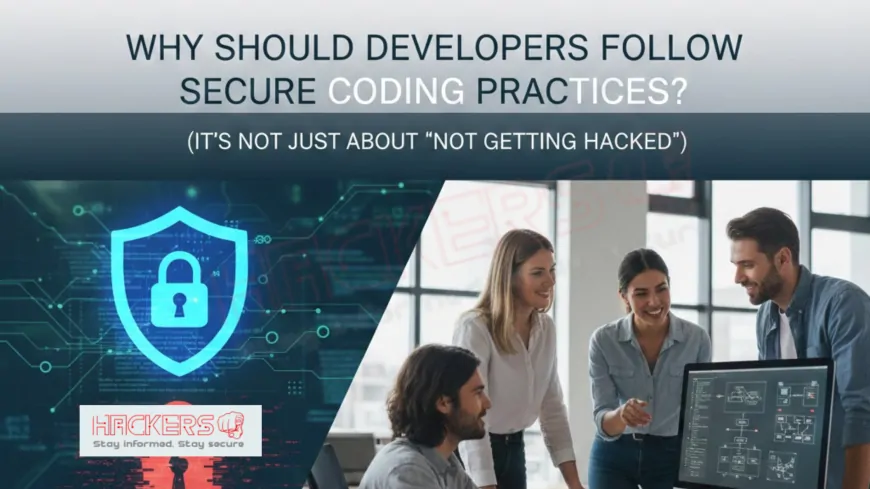
Why Should Developers Follow Secure Coding Practices? (It’s Not Just About “Not Getting Hacked”)
You are rushing to meet a deadline. The feature works perfectly on your laptop. You push the code, high-five your teammate, and move on to the next ticket. Six months later, a stranger on the internet uses one line you wrote to steal 50,000 user passwords. Suddenly your name is in a breach report, your company is paying millions, and you feel sick. This happens every single week in 2025, and the root cause is almost always the same: someone wrote code that works, but not code that is secure. Secure coding is not an extra chore for paranoid people. It is professional craftsmanship, just like writing clean, testable, maintainable code. This post explains, in plain language even junior developers and non-technical managers can understand, why secure coding should matter to every single person who writes software
.
Table of Contents
- The Real Cost When Developers Skip Security
- The Most Common (and Avoidable) Mistakes
- Why “It Works on My Machine” Is Not Enough
- Five Big Myths Developers Still Believe
- OWASP Top 10 vs. Secure Coding Fixes (2025 Edition)
- The Surprising Benefits of Writing Secure Code
- Practical Ways to Start Today
- Conclusion: Secure Coding Is Professional Pride
The Real Cost When Developers Skip Security
A single insecure line of code can trigger massive consequences:
- Average breach cost in 2025: $4.88 million (IBM)
- 43% of breaches start with a vulnerable application (Verizon DBIR 2025)
- Remediation after release is 30–100 times more expensive than fixing during development
- Careers stall: senior engineers who shipped major breaches often get passed over for promotion
- Companies lose customers forever: 60% of small businesses close within six months of a serious breach
The Most Common (and Avoidable) Mistakes
These show up in almost every penetration test:
- SQL injection: building queries by gluing strings together
- Cross-site scripting (XSS): printing user input directly into HTML
- Hard-coding secrets (passwords, API keys) in source code
- Trusting user input without validation or sanitization
- Using outdated libraries with known vulnerabilities
- Weak or missing authentication/authorization checks
- Leaking sensitive data in error messages or logs
Why “It Works on My Machine” Is Not Enough
Functional code and secure code are different things:
- Attackers do not use your happy-path test data
- They send 10,000 requests per second, not one polite click
- They read your source code on GitHub or decompile your app
- They wait patiently for you to make one small mistake
“Your code doesn’t have to be perfect. It just has to be stronger than the attacker’s patience.”
— A phrase I heard from a senior AppSec engineer in 2025
Five Big Myths Developers Still Believe in 2025
- Myth: “Security is the security team’s job.”
Reality: Security teams can only review, not rewrite every line. - Myth: “We have a WAF/firewall, so we’re safe.”
Reality: WAFs block known patterns, not logic flaws you invented yesterday. - Myth: “Nobody will target our little app.”
Reality: Attackers automate; they don’t care about your valuation. - Myth: “Adding security slows me down.”
Reality: Fixing a breach slows you down for months. - Myth: “We’ll fix it later.”
Reality: Technical debt almost never gets paid voluntarily.
OWASP Top 10 vs. Secure Coding Fixes (2025 Edition)
| 2025 OWASP Risk | Root Cause | One-Line Secure Coding Fix |
|---|---|---|
| Broken Access Control | Missing server-side checks | Always re-validate user permissions on every request |
| Cryptographic Failures | Weak algorithms or home-grown crypto | Use battle-tested libraries only (libsodium, Jetty, etc.) |
| Injection (SQL, Command, etc.) | String concatenation | Use parameterized queries / prepared statements |
| Insecure Design | No threat modeling | Ask “How could someone abuse this?” before coding |
| Security Misconfiguration | Default settings, debug on | Automate secure defaults with IaC and linting |
| Vulnerable Components | Old libraries | Run ‘npm audit’, ‘dependabot’, or ‘trivy’ in CI |
| Identification & Auth Failure | Weak password handling | Use Argon2id or bcrypt, never MD5/SHA-1 |
The Surprising Benefits of Writing Secure Code
Secure coding is not just about avoiding pain. It brings real advantages:
- Fewer bugs: input validation catches bad data early
- Cleaner code: following least-privilege forces better architecture
- Faster reviews: secure patterns are predictable and well-documented
- Stronger resume: “I ship secure code” opens doors at top companies
- Lower insurance premiums: many insurers discount for secure SDLC
- Pride: you sleep better knowing your code isn’t hurting people
Practical Ways to Start Today (No Budget Required)
- Turn on your linter’s security rules (ESLint security, Bandit, SonarQube)
- Never concatenate user input into SQL, shell, or HTML
- Store secrets in environment variables or secret managers, never in code
- Use your framework’s built-in security features (CSRF tokens, helmet.js, Spring Security)
- Add one security book to your reading list (The Tangled Web, Alice and Bob Learn Application Security)
- Run OWASP ZAP or Nuclei against your local app once a month
- Join a secure code review club with teammates (15 minutes a week)
- Ask “How would I break this?” before every merge request
Conclusion: Secure Coding Is Professional Pride
Great developers do not just make things work. They make things that cannot be easily broken. Secure coding is not a burden forced on you by security teams. It is the difference between being a coder and being a professional software engineer.
The world runs on the code we write. Real people lose money, privacy, and sometimes safety when we get it wrong. Writing secure code is one of the few things in our industry where doing the right thing also happens to be the smart thing for your career, your company, and your users.
Start small. Fix one insecure pattern this week. Then another next week. In a year, you will look back and realize you have become the kind of developer every team wants, and every attacker quietly moves past.
What exactly is secure coding?
Writing code that continues to behave correctly even when attackers try to abuse it.
Is secure coding only for security engineers?
No. Every developer who touches production code needs to understand the basics.
Does it really slow me down?
At first, maybe 5–10%. After a month of practice, you are faster because you write fewer bugs.
Why can’t we just rely on penetration tests?
Pentesters find what already exists. Secure coding prevents the problems in the first place.
Are some languages inherently safer?
Rust and Go reduce memory bugs, but logic flaws (auth, access control) exist in every language.
Do frameworks make me secure automatically?
They help, but misusing Django or Spring can still create giant holes.
What is the easiest secure habit to adopt?
Never trust user input. Validate and sanitize everything that crosses a trust boundary.
Is it okay to hard-code secrets in internal tools?
No. Internal tools become external one day, or someone forks the repo.
Should I learn hacking to write secure code?
Understanding common attacks helps enormously, but you don’t need to become a black-hat.
Will AI write secure code for me soon?
AI still copies insecure patterns from training data. Human review is required.
Does secure coding mean zero bugs?
No, but it means the bugs that remain are much harder to exploit.
Is OWASP Top 10 enough?
It is a great start, but secure coding covers far more than just those ten risks.
Do big companies actually follow secure coding?
The best ones do (Google, Microsoft, Shopify). Many still struggle, which is why breaches keep happening.
Can I get fired for insecure code?
Rarely for one mistake, but repeatedly ignoring secure practices can end careers.
What is the best free resource for learning secure coding?
OWASP Cheat Sheet Series and the free book “Alice and Bob Learn Application Security”.
Does writing secure code make me a slower developer?
Temporarily. After you internalize the patterns, you become faster and ship higher-quality work.
Is security more important than new features?
No. Both matter. Secure coding is about building features that stay safe over time.
Why do universities rarely teach secure coding?
Curriculums lag behind industry needs. Most developers learn it on the job or on their own.
Can I add secure coding to my resume?
Absolutely. “Experience applying OWASP secure coding practices” is gold to hiring managers.
Final thought: what separates good developers from great ones?
Great developers care about what happens to their code after it leaves their laptop. Secure coding is the ultimate expression of that care.
What's Your Reaction?