























Why Are Insider Threats Increasing in Hybrid Work Environments?
Sarah had worked at the company for nine years. She was quiet, reliable, and always stayed late. When the company announced another round of layoffs and told everyone to keep working from home most days, Sarah felt invisible. One Thursday night, alone in her apartment, she copied the entire customer database to her personal Google Drive “just in case.” Three weeks later she was let go. The database ended up for sale on a Russian hacking forum. Nobody saw it coming. Stories like Sarah’s are no longer rare. In 2025, insider threats (both intentional and accidental) cause more financial damage than ransomware, according to every major security report. The shift to hybrid and remote work has quietly turned one of the oldest security problems into the fastest-growing one. This post explains why insiders are suddenly the biggest risk most companies face, and what you can do about it without turning into Big Brother.
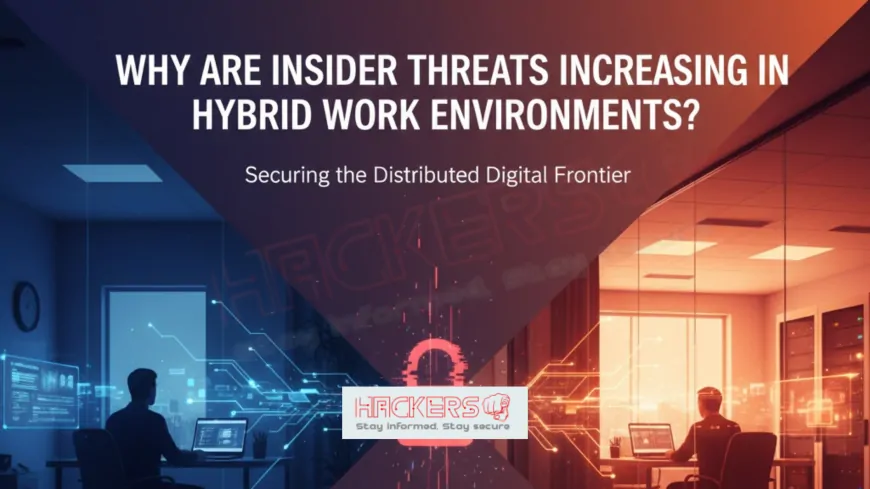
Table of Contents
- What Exactly Is an Insider Threat?
- The Numbers Don’t Lie
- Seven Reasons Hybrid Work Makes Insider Risk Worse
- The Three Types of Insiders in 2025
- Real Stories That Actually Happened
- How to Spot Insider Risk Early
- Practical Ways to Reduce Insider Risk Without Killing Trust
- Where This Is Heading
- Conclusion
What Exactly Is an Insider Threat?
An insider is anyone with legitimate access: employees, contractors, partners, or even former staff who still have credentials. The threat can be:
- Malicious (stealing data to sell or hurt the company)
- Negligent (clicking phishing links, weak passwords, lost laptops)
- Compromised (someone else is using their stolen account)
The Numbers Don’t Lie
- 68% of breaches in 2024 involved an insider (Verizon DBIR)
- Average cost of an insider incident: $16.2 million (Ponemon 2024)
- 56% of insiders are regular employees, not just disgruntled IT admins
- Remote/hybrid workers are 85% more likely to cause a data leak (Stanford study)
Seven Reasons Hybrid Work Makes Insider Risk Worse
| # | Reason | How It Helps Insiders |
|---|---|---|
| 1 | No one is watching over your shoulder | Easy to copy files unnoticed |
| 2 | Personal devices and home Wi-Fi | Company cannot control security |
| 3 | Burnout and quiet quitting | People feel less loyalty |
| 4 | More third-party apps (Slack, Notion, Zoom) | Data scattered everywhere |
| 5 | Off-boarding is messy | Ex-employees keep access for weeks |
| 6 | Shadow IT explosion | Employees use unapproved AI tools and cloud storage |
| 7 | Less face-to-face relationship with managers | Disgruntlement grows quietly |
The Three Types of Insiders in 2025
- The Careless Clicker → Opens phishing email on home network → 60% of incidents
- The Quiet Exfiltrator → Slowly downloads data before leaving for a competitor
- The Malicious Actor → Sabotages systems or sells access (thankfully rare)
Real Stories That Actually Happened
- Twitter 2020 → Teenagers bribed a remote employee for admin access
- Tesla 2022 → Employee stole robot code and took it to a Chinese competitor
- Bank 2024 → Remote finance worker copied customer records to personal OneDrive before layoff
- Healthcare chain 2025 → Nurse working from home sold patient data on Telegram from her couch
How to Spot Insider Risk Early
- Unusual download volumes or times (3 a.m. on Sunday)
- Accessing files they never touched before
- Logging in from new countries or devices
- Disabling MFA or using legacy authentication
- Sudden complaints or negative sentiment in Slack/Teams
- Searching for “how to delete logs” or “exfiltrate data” in browser”
Practical Ways to Reduce Insider Risk Without Killing Trust
- Enforce least privilege – give access only to what people need today
- Use managed devices with full disk encryption and remote wipe
- Make off-boarding automated (HR ticket → access gone in <1 hour)
- Deploy User and Entity Behavior Analytics (UEBA) tools
- Train people that data exfiltration is theft, just like taking a laptop
- Create clear policies for personal devices and cloud storage
- Run “friendly phishing” tests and reward safe behavior
- Offer mental health support and stay interviews to spot unhappiness early
- Use DLP (Data Loss Prevention) that works on home networks
- Make managers responsible for access reviews every 90 days
Where This Is Heading
- Zero-trust architectures will become mandatory for hybrid work
- AI will watch behavior analytics in real time (Microsoft, Google, CrowdStrike already do this)
- Insurance companies will demand insider risk programs
- “Bring Your Own AI” will create new shadow data risks
Conclusion
Hybrid work is not going away. That means insider threats are not going away either. The companies that win will be the ones that stop treating insiders as “trusted by default” and start treating access like the precious thing it is.
You do not need to spy on every keystroke. You need visibility, fair policies, quick off-boarding, and a culture where people feel valued enough not to steal when times get hard.
Because in the end, the biggest insider threat is not technology. It is a human being who feels they have nothing left to lose.
What is an insider threat?
Any risk caused by someone who has legitimate access to systems or data.
Are most insiders malicious?
No. Over 60% are accidental or negligent, not evil.
Is remote work the main cause?
It is a major accelerator, but burnout, layoffs, and poor access control existed before COVID.
Do small companies have insider risk?
Yes. A single angry employee can destroy a startup overnight.
Can I monitor personal laptops?
Yes, but only with strong MDM (mobile device management) and containerized apps.
Is it legal to monitor employees at home?
Yes in most countries if you tell them in advance and monitor company data only.
Will AI solve insider threats?
It helps detect anomalies, but it cannot fix bad culture.
What is the most common insider incident?
Sending company files to personal email or cloud storage.
Do contractors pose higher risk?
Yes. They often have wide access and leave suddenly.
Should I block USB drives?
Yes for sensitive environments, or at least encrypt and log them.
Can I fire someone for risky behavior?
Yes, if you have clear policy and evidence (e.g., uploading source code to GitHub).
Is shadow IT a type of insider threat?
Yes. Using unapproved tools often leads to data leaks.
Do layoffs increase insider risk?
Dramatically. Many incidents happen in the last two weeks of employment.
Can I use the same tools as for external threats?
Partly, but insider tools need to focus on behavior, not just malware.
Is it expensive to protect against insiders?
Not really. Basic access reviews and automated off-boarding cost almost nothing.
Do background checks stop insiders?
They help with malicious hires, but most insiders “turn bad” after years of service.
Should I be worried about AI tools like ChatGPT?
Yes. Employees paste code and customer data into public AI every day.
Is it possible to have zero insider risk?
No, but you can reduce it to an acceptable level with the right culture and controls.
What is the number one thing I can do today?
Make sure every employee and contractor’s access is removed within one hour of their last day.
Will insider threats get worse?
Yes, until companies treat access as seriously as they treat external hackers.
What's Your Reaction?