

















How Does Blockchain Improve Cybersecurity in Data Protection?
Most people first heard about blockchain because of Bitcoin, but over the past few years something much bigger has happened. Experts have realized that the same technology that powers cryptocurrencies can also solve some of the toughest problems in cybersecurity, especially when it comes to protecting data. In a world where data breaches happen almost daily and hackers steal millions of records, blockchain offers a completely different way of thinking about trust, security, and control. Imagine a system where data cannot be secretly changed, where every action is recorded forever, and where you don’t have to trust a single company or person to keep things safe. That is the promise of blockchain for data protection. This article explains, in simple terms, how blockchain actually makes our digital world safer and why more organizations are starting to use it.
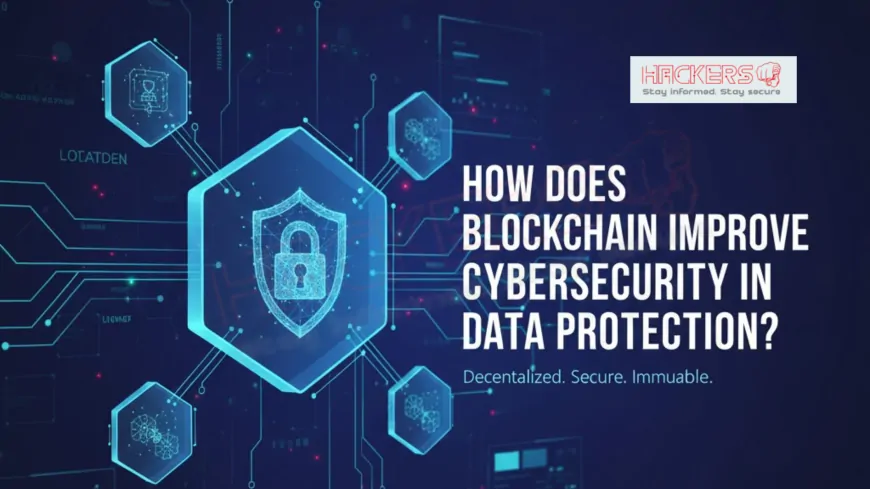
Table of Contents
- What Exactly Is Blockchain? A Simple Explanation
- Traditional Data Protection vs. Blockchain-Based Protection
- How Immutability Stops Tampering
- Why Removing the Single Point of Failure Matters
- The Role of Strong Cryptography in Blockchain
- Blockchain and Identity Protection
- Permanent Audit Trails You Can Actually Trust
- Real-World Examples of Blockchain Improving Security
- Challenges and Limitations You Should Know
- Conclusion
- Frequently Asked Questions
What Exactly Is Blockchain? A Simple Explanation
Think of blockchain as a digital notebook that many people share. Every time someone writes something new in the notebook, everyone gets a copy of that page. Once a page is full and added to the notebook, it can never be erased or changed without everyone noticing. Each new page also contains a unique fingerprint of the previous page, so the whole history is linked together.
In technical terms, a blockchain is a distributed ledger. “Distributed” means copies live on thousands of computers instead of one server. “Ledger” means every transaction or record is permanently written down. When a new record is added, it is grouped into a block, given a timestamp, and linked to the previous block using cryptography. This creates an unbreakable chain.
Most importantly, no single person or company controls the entire chain. Everyone follows the same rules, and changes need agreement from the network. This structure is what gives blockchain its security superpowers.
Traditional Data Protection vs. Blockchain-Based Protection
Let us compare the two approaches side by side so the difference is clear.
| Feature | Traditional Systems | Blockchain Systems |
|---|---|---|
| Where data is stored | Central servers owned by one organization | Thousands of independent computers (nodes) |
| Who can change records | Admins or hackers who gain access | Practically impossible without network agreement |
| Single point of failure | Yes: if the main server is hacked, everything is at risk | No: the system keeps working even if some nodes fail |
| Trust model | Trust the company or database owner | Trust the math and cryptography, not people |
| Transparency | Usually hidden; only admins see logs | Anyone can verify the history (in public blockchains) |
This table shows why many experts believe blockchain is a major step forward for data protection.
How Immutability Stops Tampering
One of the strongest features of blockchain is immutability: once data is written, it cannot be altered without breaking the entire chain. Every block contains a cryptographic hash (a unique digital fingerprint) of the previous block. If someone changes even one character in an old record, the hash no longer matches, and the whole network rejects it.
In real life, this means:
- A hacker who breaks into a hospital database cannot quietly change patient records.
- A dishonest employee cannot delete evidence of fraud from financial logs.
- Government officials cannot secretly modify voting records.
Immutability is why companies like IBM and Maersk use blockchain to track shipping containers: everyone knows the recorded journey is accurate and untampered.
Why Removing the Single Point of Failure Matters
Most big data breaches happen because hackers find one weak door: a poorly protected server, a stolen password, or an unpatched system. Once inside, they can steal or destroy everything.
Blockchain removes that single door. There is no central server to attack. To change data, an attacker would need to control more than 50 percent of all nodes at the same time, which becomes almost impossible on large networks. This is called a 51% attack, and on major blockchains it would cost billions of dollars and still likely fail.
Decentralization was proven during the 2017 WannaCry ransomware outbreak. Traditional hospitals lost access to patient files because their central servers were locked. Systems using decentralized blockchain storage kept working because there was no single point to shut down.
The Role of Strong Cryptography in Blockchain
Blockchain uses two proven cryptographic tools:
- Hash functions (like SHA-256): turn any amount of data into a fixed-length string that cannot be reversed.
- Public-private key pairs: you sign transactions with your private key (which only you know), and anyone can verify the signature with your public key.
These tools have protected Bitcoin for over 15 years without a single successful hack of the core protocol. The same cryptography now protects medical records, supply-chain data, and digital identities.
Blockchain and Identity Protection
Identity theft is one of the biggest problems today. Criminals steal usernames and passwords from central databases and use them everywhere.
Self-sovereign identity (SSI) on blockchain fixes this. Instead of giving your personal details to dozens of websites, you store an encrypted identity wallet on your phone. When a service needs proof of age or address, you share only that specific piece of information, signed by a trusted issuer (like a government). Nothing is stored on a central server that can be hacked.
Projects like Microsoft ION and the European Union’s EBSI are already building these systems.
Permanent Audit Trails You Can Actually Trust
Traditional audit logs are stored on the same server as the data. If a hacker gets admin rights, they can delete or change the logs to cover their tracks.
With blockchain, every action (who accessed what, when, and why) is written to an immutable ledger. Auditors, regulators, or even customers can verify the history themselves. This transparency has been a game-changer in pharmaceutical supply chains, where companies must prove drugs were stored at the correct temperature from factory to pharmacy.
Real-World Examples of Blockchain Improving Security
- Guardtime and the Estonian government: since 2008, Estonia has used blockchain to protect over 1 billion health records and government transactions.
- IBM Food Trust: Walmart and other retailers track food from farm to shelf on a blockchain, reducing fraud and speeding up recalls.
- Medicalchain and Doc.com: patients control who sees their medical history and get paid small amounts when researchers use their anonymized data.
- Deutsche Bank and HSBC: use blockchain platforms like R3 Corda for secure inter-bank settlements without exposing sensitive data.
- UNICEF CryptoFund: accepts and tracks donations on blockchain so every dollar is visible and cannot disappear.
Challenges and Limitations You Should Know
Blockchain is powerful, but it is not perfect yet.
- Speed: public blockchains can be slower than traditional databases.
- Energy use: some blockchains (especially proof-of-work) consume a lot of electricity, though newer proof-of-stake networks use far less.
- Storage: keeping everything forever can become expensive.
- Private keys: if a user loses their private key, their data is gone forever; if it is stolen, the thief has full control.
- Regulation: governments are still figuring out the legal rules.
Most of these issues are being solved with newer blockchains (layer-2 solutions, private/permissioned networks, and better wallet designs).
Conclusion
Blockchain does not solve every cybersecurity problem, but it solves some of the hardest ones in completely new ways. By making data immutable, removing single points of failure, using military-grade cryptography, and giving people control over their own identities, blockchain moves us from “trust the company” to “trust the math.”
As cyberattacks grow more frequent and costly, organizations and governments are turning to blockchain not just for cryptocurrency, but as a foundational layer for trustworthy data protection. The next decade will likely see blockchain become as common in cybersecurity as firewalls and antivirus software are today.
Frequently Asked Questions
What is blockchain in simple words?
Blockchain is a shared digital record book that many computers keep copies of. Once something is written, it cannot be changed without everyone noticing.
Does blockchain stop all hacking?
No, but it makes many common attacks useless because data cannot be secretly altered or deleted.
Is blockchain only for Bitcoin?
No. Bitcoin uses blockchain, but the same technology now protects medical records, supply chains, voting systems, and more.
How does blockchain prevent ransomware?
If critical data is stored immutably on a blockchain, attackers cannot encrypt or delete it to demand ransom.
What is a hash in blockchain?
A hash is a unique digital fingerprint of data. Change one letter and the hash completely changes, alerting the network.
Why is decentralization safer?
There is no single server to attack. An attacker would need to take over thousands of independent computers at once.
Can blockchain be hacked?
The core protocol of large blockchains has never been hacked. Weaknesses usually appear in poorly written smart contracts or lost private keys.
What is a private key?
It is a secret password that proves you own your data or cryptocurrency. Keep it safe and never share it.
How does blockchain help with identity theft?
With self-sovereign identity, you never give away your full personal details. You prove only what is needed without central storage.
Is blockchain slow?
Older blockchains can be slower than traditional databases, but modern solutions process thousands of transactions per second.
Does blockchain replace the need for backups?
Not completely, but because data is replicated across thousands of nodes, the risk of total loss is extremely low.
Why do some blockchains use so much energy?
Older proof-of-work systems require computers to solve puzzles. Newer proof-of-stake systems use a tiny fraction of that energy.
Can companies use blockchain privately?
Yes. Permissioned or private blockchains let organizations enjoy the security benefits while keeping data confidential.
Is blockchain regulated?
Rules vary by country. Most governments regulate cryptocurrencies more strictly than the underlying blockchain technology.
Will blockchain make passwords obsolete?
Many experts believe private-key cryptography on blockchain will eventually replace passwords for most online services.
How are banks using blockchain for security?
Banks use blockchain to secure cross-border payments, trade finance, and customer identity verification without exposing sensitive data.
Can blockchain protect Internet of Things devices?
Yes. Projects like IOTA and Helium use blockchain to let devices communicate and update securely without a central server.
What is the difference between public and private blockchains?
Public blockchains (Bitcoin, Ethereum) are open to anyone. Private blockchains are controlled by a group of organizations and offer more privacy.
Is blockchain the future of cybersecurity?
It will not replace everything, but it is becoming a critical new layer for data integrity, identity, and trust in digital systems.
Where can beginners learn more about blockchain security?
Start with free courses on Coursera, edX, or the Linux Foundation. Many blockchain projects also publish easy-to-read whitepapers.
What's Your Reaction?